



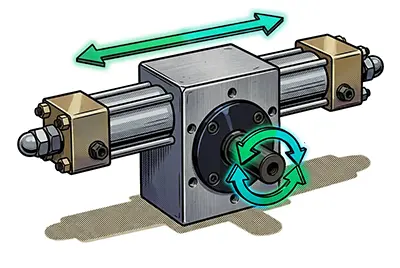
In modern industrial plants, the ability to convert the linear motion generated by hydraulic cylinders into rotary motion represents a fundamental engineering solution for simplifying mechanical systems. This transformation makes it possible to eliminate complex kinematic systems made up of multiple rigid elements connected to each other, replacing them with a more compact, efficient and easily maintainable system.
read more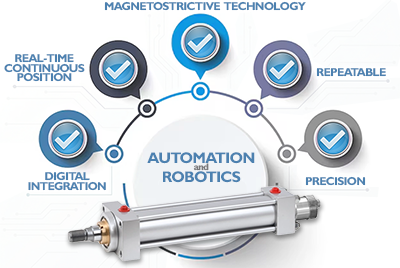
In modern industrial automation, the choice of actuation system is a decision that directly impacts the quality of the finished product, line productivity and the complexity of integration with control systems. In this context, hydraulic cylinders are still perceived today by some designers as a "traditional" technology, suited to power but less to precision. This is a perception that deserves to be reviewed with data in hand.
read more
A sudden failure of a hydraulic cylinder can paralyse an entire production line within moments.
The metallic noise of a jammed piston, the sudden oil leak from a compromised seal, or the structural failure of a rod represent scenarios that every maintenance manager knows all too well.
As seconds turn into minutes and hours accumulate, downtime costs grow exponentially: halted production, delayed deliveries, contractual penalties and dissatisfied customers. In high intensity industrial production environments, one hour of inactivity can translate into economic losses ranging from thousands to tens of thousands of euros.
read more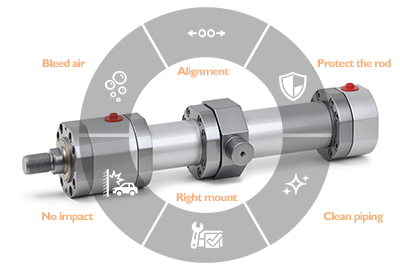
A hydraulic cylinder built with top-quality materials, tested in accordance with ISO 10100 standards, fitted with a chrome-plated rod and high-quality seals can still fail within a few weeks. Not because of a manufacturing defect, but because of a mistake made during installation. In industrial practice, a significant share of premature cylinder failures can be traced back to assembly errors that could have easily been avoided.
This guide brings together the fundamental rules that every technician should apply when installing hydraulic cylinders on their machinery. Following them means extending the service life of the component, avoiding unplanned maintenance and protecting the entire hydraulic system.
read more
In today's industrial landscape, where margins are thinning and competitiveness is measured in fractions of efficiency, the choice of hydraulic components represents a strategic decision that goes well beyond comparing list prices.
A hydraulic cylinder purchased at a low price may appear to be a saving, but this can rapidly turn into a loss when the component fails during a production cycle.
read more
When it comes to reliability in industrial hydraulic systems, quality is not an option but an absolute necessity. 100% cylinder testing is a quality control procedure that involves verifying every single product rather than relying on sampling. The goal is operational excellence, because a hydraulic cylinder that fails during a production process can cause costly machine downtime, compromise operator safety, and damage a company's reputation. For this reason, hydraulic cylinder testing represents a critical phase of the manufacturing process.
read more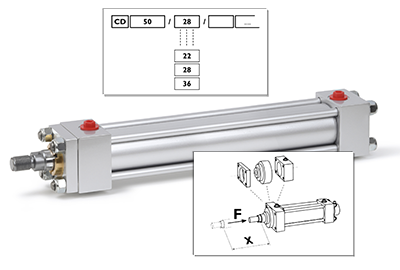
When integrating a hydraulic cylinder into a new project, you need to analyse and evaluate the different requirements in order to define the dimensional and functional characteristics of the product to be used. You will then need CAD drawings, complete technical data sheets, and the assurance that the dimensions correspond exactly to your specifications. Traditionally, this process required contact with suppliers, waiting for quotations, and repeated exchanges that could take days. The Conforti hydraulic cylinder CAD configurator eliminates this waiting time, allowing you to follow a guided product selection process — with real-time feasibility and compatibility checks — and to automatically generate all the technical documentation in a matter of minutes.
read more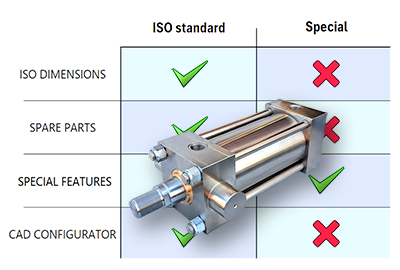
Anyone designing a hydraulic system or replacing an actuator will sooner or later face a choice that appears simple but is anything but: is it better to opt for an ISO hydraulic cylinder, available from catalogue with guaranteed lead times, or to invest in a special engineered hydraulic cylinder, designed precisely for that specific application?
The answer depends on a technical and operational analysis that goes well beyond the unit price of the component. It depends on the working environment, the space available within the machine, the fluids used, the load cycles, and the future availability of spare parts but above all it depends on an aspect that is very often underestimated: how much customisation is already accessible within a configurable ISO cylinder, without sacrificing the benefits of standardisation.
read more
Selecting a hydraulic cylinder is a critical phase in the design of any industrial hydraulic system. An error at this stage can compromise the efficiency of the entire application, cause premature failures, and generate unexpected maintenance and machine downtime costs. According to industry statistics, the most common cause of cylinder malfunctions is the selection of an inadequate product rather than manufacturing defects. This article analyses the five most frequent errors engineers make when selecting hydraulic cylinders, providing practical solutions to avoid them.
read more
Conforti integrates magnetic sensors, IO-LINK and magnetostrictive transducers in hydraulic cylinders to continuously monitor piston position, improve control, safety and predictive maintenance, facilitating integration into automated systems and heavy-duty applications with a view to Industry 4.0.
read more