

 Italiano
 Deutsch
 English
 Français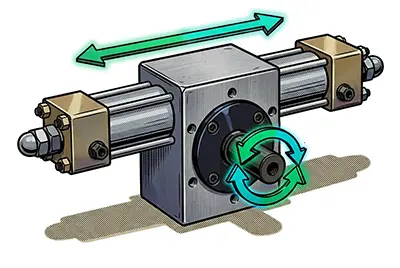
In modern industrial plants, the ability to convert the linear motion generated by hydraulic cylinders into rotary motion represents a fundamental engineering solution for simplifying mechanical systems. This transformation makes it possible to eliminate complex kinematic systems made up of multiple rigid elements connected to each other, replacing them with a more compact, efficient and easily maintainable system.
Hydraulic rotary actuators are born precisely to respond to this need, integrating into a single component the power of hydraulic cylinders and the versatility of rotary motion.
Motion conversion is not only a technical issue but often represents the key to optimising the available space, reducing maintenance costs and increasing the overall reliability of the system.
In sectors such as industrial automation, earth-moving machinery and lifting systems, this technology finds daily applications that contribute to production efficiency.
The operating principle of rotary actuators
Hydraulic rotary actuators operate according to a simple mechanical principle: a double-acting hydraulic cylinder drives a rack which, in turn, meshes with a pinion gear integral with the output shaft. When the pressurised hydraulic fluid enters the cylinder chamber, the piston moves linearly pushing the rack. This rectilinear movement of the rack rotates the pinion gear, transforming the linear thrust into rotary torque on the output shaft.
The heart of this system is the rack-and-pinion mechanism, a kinematic solution that guarantees a constant and predictable transmission ratio. Unlike other motion conversion systems, this configuration offers the advantage of generating high torques while maintaining compact dimensions. The geometry of the teeth ensures a precise coupling that minimises efficiency losses and ensures a long operating life even in harsh conditions.
In Conforti actuators, the presence of adjustable end-of-stroke adjusters allows phase adjustment of the system with an adjustment range of ±5°, allowing millimetric adjustments to adapt the actuator to the specifications of the application. This level of precision is decisive in applications where angular positioning must respect tight tolerances.
Advantages of simplifying kinematic systems
The replacement of complex kinematic chains with a rotary actuator brings tangible benefits on several fronts. First of all, a drastic reduction in overall dimensions is achieved: where supports, joints, levers and articulated connections were previously required, now a single integrated component performs the entire function. This compactness translates into greater design freedom and the possibility of optimising the space available on the machine.
From a maintenance point of view, the rack-and-pinion system enclosed in a single body significantly reduces the number of wear points and critical connections. Fewer components means less possibility of failure and simpler, faster maintenance interventions. Direct accessibility to the mechanism facilitates inspections and replacements, reducing machine downtime.
Energy efficiency represents a further advantage. This greater efficiency translates into lower heat generation and quantifiable energy savings over the plant's life cycle.
Technical characteristics and performance
Modern rotary actuators can generate significant torques while maintaining compact dimensions. The models cover a wide range of performance: from compact solutions with torques of 6 daNm up to more robust units capable of delivering over 120 daNm. The typical working pressure is around 100 bar, allowing heavy loads to be managed safely.
The constructive versatility allows actuators to be made with rotation angles variable from 90° up to 270°, covering practically every application need. For each degree of rotation there corresponds a specific stroke of the internal cylinder. This direct and proportional relationship guarantees positioning precision and repeatability.
The integrated adjustable cushioning systems represent a distinctive feature of particular value. This functionality is essential in applications where it is necessary to stop moving masses or maintain precise positions without the continuous intervention of the hydraulic system.
Position control and monitoring
Technological evolution has led to the integration of detection systems that transform rotary actuators into intelligent components. Versions equipped with magnetic piston and stainless steel barrel allow magnetic sensors to be positioned along the cylinder stroke. These sensors, fixed to the tie-rods by means of specific brackets, detect the passage of the piston providing precise feedback on the angular position of the shaft.
Traditional REED or PNP magnetoresistive type sensors offer discrete signalling, ideal for confirming the achievement of preset positions. For applications requiring even more sophisticated control, there are programmable sensors capable of detecting the piston within a variable range and providing continuous position via digital signal.
These advanced devices also allow programming two circuit-closing intervals modifiable via software, even on board the machine, offering operational flexibility without mechanical interventions.
The digital connection of these intelligent sensors makes it possible to monitor additional parameters such as the working temperature, enabling predictive maintenance based on the actual operating conditions. This level of information integrates perfectly with modern industrial automation systems, contributing to the digitalisation of production plants.
Concrete industrial applications
In the machine tools sector, rotary actuators find use in the actuation of rotary clamps, in tool change systems and in the positioning of rotary tables. The angular precision and the ability to maintain position under load make them ideal for milling and multi-axis machining operations, where repeatability is critical for the quality of the finished product.
Industrial presses benefit from the use of rotary actuators for controlling the inclination of dies and press brakes. The high torque available allows heavy dies to be moved while maintaining full control of the movement.
Lifting and handling systems use rotary actuators to orient loads, rotate platforms and control automatic distribution systems. The possibility of generating rotary motion from a single compact system considerably simplifies the design of automated solutions, reducing the number of necessary components and facilitating integration into existing systems.
Design considerations for integration
The choice of a rotary actuator requires a careful analysis of the operating conditions. The necessary torque is calculated by considering not only the static load to be moved, but also the required accelerations and the resistances due to friction and inertia.
The mechanical anchorage of the actuator must be designed to withstand both the reaction torques during operation and the stresses deriving from vibrations and impacts. The rigidity of the support directly influences positioning precision and the durability of the internal mechanical components. In critical applications, it may be appropriate to use anti-vibration supports to isolate the actuator from external stresses.
Conclusions
This technology eliminates the complexity of articulated mechanical systems, offering the designer a versatile tool that combines power, precision and ease of maintenance. The progressive integration of intelligent detection systems is further expanding the application possibilities, making these components increasingly central in modern automation systems.
For applications requiring rotary motion, evaluating the use of hydraulic rotary actuators can lead to more efficient and reliable solutions. The experience of Conforti Oleodinamica in the design of hydraulic cylinders makes it possible to identify the optimal configuration for each specific need, guaranteeing high performance and durability over time.
For technical insights on selecting the most suitable components for your applications, you can consult the complete range of ISO 6020/2 cylinders and compact cylinders, complementary solutions that, integrated with rotary actuators, allow complete and high-performance hydraulic systems to be realised.