

 Italiano
 Deutsch
 English
 Français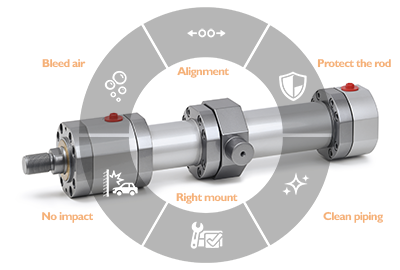
A hydraulic cylinder built with top-quality materials, tested in accordance with ISO 10100 standards, fitted with a chrome-plated rod and high-quality seals can still fail within a few weeks. Not because of a manufacturing defect, but because of a mistake made during installation. In industrial practice, a significant share of premature cylinder failures can be traced back to assembly errors that could have easily been avoided.
This guide brings together the fundamental rules that every technician should apply when installing hydraulic cylinders on their machinery. Following them means extending the service life of the component, avoiding unplanned maintenance and protecting the entire hydraulic system.
Perfect alignment between cylinder and guided load
This is the most important rule and the one most frequently overlooked. When the cylinder is not perfectly aligned with the load it has to move, the rod is subjected to radial loads: lateral forces it should not receive, because it is designed to work exclusively along the axial direction.
Radial loads cause accelerated wear of the bronze guide bushing and of the rod seals. In applications with particularly long strokes, they can generate bending moments that negatively interact with the rod-piston guide, leading to premature deterioration even after just a few months of operation.
The solution is not always straightforward: misalignments may already be present in the machine structure or appear over time due to thermal deformations or yielding of the supports. This is why it is essential to check alignment not only at the time of installation, but also after the first operating hours and periodically throughout the operational life of the cylinder.
Equally important is the choice of mountings that allow greater degrees of freedom, preventing cylinders from operating in rigid systems that could trigger stress and breakages.
When lateral load is unavoidable, the choice of cylinder type becomes decisive. DP series cylinders compliant with ISO 6022, for instance, feature a double bronze guide on the piston and an extended bronze guide bushing, specifically designed to handle unwanted radial loads without compromising barrel life.
Avoid impacts and shocks at end of stroke
This is a mistake that may seem harmless, but it causes rapid and costly damage. The heads of hydraulic cylinders are not designed to absorb piston impact at the end of stroke: when the moving load strikes the head instead of being stopped by an external system, the peak pressures generated internally can far exceed the nominal working pressure.
The solution is to prevent impacts from occurring during the work cycle, both inside the cylinder and outside in the application. The correct practice is always to provide external mechanical stops that halt the load before the rod reaches the end of stroke. Where the machine requires a gradual deceleration before stopping, cylinders can be equipped with adjustable end-of-stroke cushioning integrated into the heads: a system that dissipates kinetic energy in a controlled manner by restricting oil flow, with the possibility of adjusting the braking effect through a calibrated needle valve.
Bear in mind that integrated cushioning systems are sized to slow down movement, not to replace the external mechanical stop.
Protect the rod throughout the entire installation phase
The chrome-plated rod is the most exposed component and the one where one of the main causes of seal failure is concentrated. Standard chrome plating guarantees optimal sealing and smooth sliding, but requires care during handling and installation.
A deep scratch on the rod, caused by an accidental impact with a tool or with an edge of the structure during mounting, quickly becomes a preferential path for oil leakage. Seals, however high their quality, cannot compensate for permanently damaged surfaces.
The practical rules are simple: never rest tools or metal objects on the rod during installation, do not use the cylinder as a support for other components, and keep the protective caps on the oil ports in place until the piping is connected. In environments with high levels of dust or metal chips, it is advisable to consider the use of metal scrapers, which prevent foreign particles from entering the guide bushing during cylinder operation.
Bleeding the air before commissioning
Air trapped in the hydraulic circuit is a problem that often appears at first start-up: irregular movements, unstable rod behaviour, abnormal noise.
Before pressurising the system, it is necessary to carry out low-pressure bleeding cycles, gradually opening the valves and letting air escape from the bleed ports provided on the heads. For horizontally mounted cylinders, the bleed port must be located at the highest possible point to allow complete air evacuation.
During first start-up cycles, it is good practice to have the rod perform full strokes forward and backward at reduced speed, checking that the movement is smooth and free of jerks before bringing the system to nominal pressure and speed.
Connecting the piping with attention to cleanliness and tightening torque
One of the main causes of early deterioration of seals and internal components is hydraulic oil contamination, often introduced during assembly through the piping itself. Before connection, every pipe and fitting must be carefully cleaned internally: machining residues, chips or oxidation that enter the cylinder during the first cycles can cause immediate damage to the sealing surfaces.
Fitting tightening is another critical point. Insufficient tightening generates external leaks; excessive tightening can deform threads or damage the sealing surfaces of the fittings, with similar consequences. Always use the torque values specified by the fittings manufacturer, avoiding any improvisation.
For applications in environments with strokes exceeding 2000 mm or high speeds, it may be necessary to provide drainage of the guide bushing to allow the removal of excess fluid: an option available both on CD/DK/MD series and DP series cylinders, which prevents pressure build-up between the scraper and the rod seal.
Choosing the correct mounting type according to stroke and application
The cylinder mounting type is not an accessory detail: it directly influences the distribution of mechanical loads and, consequently, the service life of rod, guide and seals. A fixed rigid mounting (front or rear flange, foot mounts) is ideal when the load moves in a straight line and the cylinder does not need to rotate. Conversely, if the load application point is not rigidly aligned with the cylinder, or if the system geometry generates angular variations during the cycle, an articulated mounting with a clevis or trunnion is required, allowing the cylinder to adapt to movement without transferring bending loads to the guide.
Assembly quality is an integral part of cylinder quality
A hydraulic cylinder is a precision system: every component, from the honed barrel to the polyurethane or Viton® seals, is sized to work within defined parameters. Complying with these rules during assembly means ensuring that those parameters are actually respected in operation, day after day.
If you are designing an installation and have doubts about the most suitable mounting, the correct cylinder type for your application or the management of radial loads, the technical team at Conforti Oleodinamica is at your disposal for dedicated support. You can also explore the complete range of heavy-duty DP series hydraulic cylinders, designed for the most demanding operating conditions.